Schedule 13D vs Schedule 13G: Definition, Filing Rules, and What Each Signals
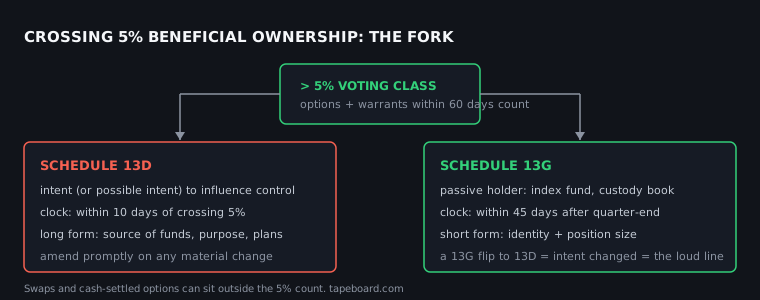
Schedule 13D and Schedule 13G are the two SEC filings required when an investor crosses 5% of a class of voting shares, and which one is used tells you whether the holder plans to influence the company or simply hold a passive stake.
13D vs 13G: Plain-English Definition
When any investor beneficially owns more than 5% of a class of a public company's voting securities, SEC Section 13 rules require a public filing, and there are two flavors. Schedule 13D is the long-form notice used by investors who have, or may develop, an intent to influence or change control of the company. Schedule 13G is the short-form version for passive holders. The split is the signal: a 13D arriving on a small cap often precedes activist campaigns, proxy fights, or takeover approaches, while a 13G usually means an index fund, a bank's custody book, or a value investor who just sits there.
How the Rules Work
The thresholds and clocks:
Trigger: beneficial ownership crosses 5% of the voting class

Schedule 13G (passive, e.g. institutional/QIXX exemption):
  - File within 45 days after quarter-end of acquisition
  - Amended only at year-end (or promptly on material changes/5% band exit)
Schedule 13D (anyone who could influence control):
  - File within 10 days of crossing 5%
  - Amend "promptly" on material changes to the facts reported

Both require amendments when ownership moves across whole percentage points
(13D) or crossing 10% and 20% bands (13G for certain holders)
"Beneficial ownership" includes shares a holder has the right to acquire within 60 days through options, warrants, and convertible securities, which is why activist stakes are often larger on a fully-diluted basis than the headline number.
Worked Example
Suppose a $200 million market cap industrial has a hedge fund cross 5.1% and file a 13D. The filing's Item 4 (purpose of transaction) says the fund is "evaluating strategic alternatives for the company and may seek board representation." That single sentence historically precedes proxy activity a large fraction of the time, and the stock usually reprices the possibility immediately. Contrast a 13G from a passive index manager at 5.3%: same threshold, same filing obligation, no signal at all beyond a routine reconstitution. The actionable edge is in the 13D's amendment cadence: a quick amendment raising the stake after the initial pop signals the buyer is still working, while silence past the 10-day window often means the position is being managed rather than accumulated.
When Traders Watch Them
13D/13G flow is a core surface for event-driven trading: the initial filing is the timestamp of a new potentially active owner, and each amendment is a progress report on the campaign. Watch for 13Ds filed by known activist managers, group filings (multiple funds acting as a group must file jointly), and 13D/13G flips, where a passive 13G holder converts to a 13D because intent changed, which is often the single loudest line in the whole dataset.
Tapeboard ingests ownership filings as they hit EDGAR in the filings feed, and per-ticker ownership context appears alongside insider trades on every stock page.
Limitations and Common Misconceptions
The 5% trigger is on beneficial ownership, not economic exposure: total-return swaps and cash-settled options can give an activist economic exposure far above 5% without any 13D obligation, a gap the SEC has repeatedly examined but not closed. The 13G's late deadline (45 days after quarter-end) means passive stakes can be months stale when published. Neither filing is a buy or sell signal by itself; most 13Ds go nowhere beyond a re-rating, and plenty of control-seeking stakes fail. And a 13G can be an under-disclosed 13D in disguise: holders sometimes stretch the "passive" designation, which occasionally draws SEC comment letters well after the position was built.
Related Terms
Related reading: Form 4 filings for the insider side of ownership disclosure, shelf registration and at-the-market offerings for the issuance side that activist stakes often push back on, and short squeeze mechanics, since crowded shorts and new 13D buyers feed on each other.