What is an At-the-Market (ATM) Offering? Definition, Mechanics, and Why It Drains Runners
An at-the-market offering is a standing program that lets a company sell newly issued shares into the live market through a broker at whatever the current price is, converting every rally into a steady drip of dilution.
At-the-Market Offering: Plain-English Definition
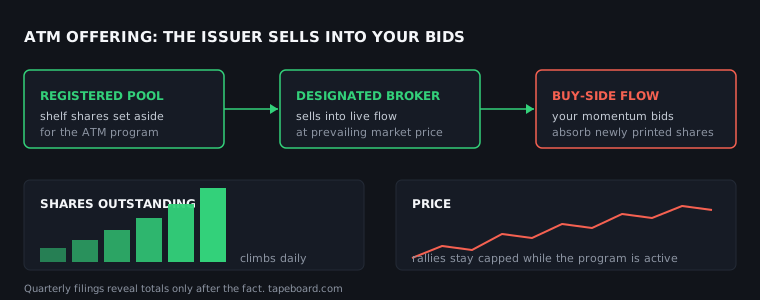
An at-the-market (ATM) offering is a sales program under which a company sells newly created shares into the open market, at market prices, whenever it wants, through a designated broker. Instead of pricing one big overnight raise, the company registers a pool of shares (usually on a shelf) and then sells them gradually into existing buy-side flow. The company becomes a persistent seller inside its own stock. For a trader, an active ATM on a low-float name means the bid you are lifting is being partly manufactured for you by the issuer.
How It Works
The moving parts:
1. Company signs an ATM equity distribution agreement with a broker-dealer
2. Shares are registered (usually via shelf, Rule 415)
3. Company files a prospectus supplement naming the program size
4. Each day it wants to sell, it notifies the broker (volume, price floors)
5. Broker sells into live order flow at prevailing prices
6. Proceeds arrive in days; disclosures land in the next 10-Q/10-K
   (aggregate quarterly totals) rather than daily
The disclosure cadence is the trap for retail flow: aggregate ATM sales appear in quarterly filings, so a program can quietly move hundreds of thousands of shares a day for weeks before any headline is written. The broker's sales are exempt from Rule 10b-18 buyback-style limits; there is no daily disclosure requirement comparable to insider Form 4s.
Worked Example
Take a hypothetical biotech trading 40 million shares a day at a $3.00 handle with a 25 million share float and a $75 million ATM program outstanding. Suppose the company sells 2 million shares a day into that volume for two weeks at an average $2.90. That is 28 million new shares, more than the entire pre-program float, printed without a single press release. The chart shows a stock that "cannot break out" despite constant volume, because every breakout attempt is being sold into by the one seller with unlimited supply at zero cost basis. When the 10-Q finally shows the ATM drawdown, the move has already happened.
When Traders Check It
ATM status is a pre-trade check on any low-float momentum name, in the same bucket as shelf capacity and reverse-split history. The tells are a prospectus supplement mentioning an "at-the-market offering" or "sales agreement", an unusually clean distribution pattern that grinds down on volume, and quarterly filings showing steady share-count creep. On names where the program is nearly exhausted, the risk profile flips: supply pressure ends when the pool does.
Tapeboard flags new prospectus supplements and equity-program filings in the filings feed, and the live scanner shows the volume-vs-price divergence pattern a working ATM usually prints.
Limitations and Common Misconceptions
An announced ATM is not an active ATM: programs are frequently sized but left dormant for months, and issuers often stop selling into genuine price strength to avoid killing the bid. ATM activity is also not inherently bearish for a company, since the cash funds operations; it is bearish for the float structure and for anyone underwriting the supply side incorrectly. Do not confuse an ATM with a registered direct offering (a one-time negotiated block usually sold overnight) or a private placement under Regulation D. And note the data lag: aggregate sales figures arrive quarterly, so absence of a filing is not absence of selling.
Related Terms
Related reading: shelf registration, which is where the ATM shares come from, reverse split as the reset mechanism issuers use after a finished ATM, days to cover for how dilution interacts with short-side positioning, and float utilization for what happens to the borrow market when the tradable float balloons.