What is a Shelf Registration? Definition, Mechanics, and Dilution Risk
A shelf registration is an SEC filing under Rule 415 that lets a company pre-register up to three years of future securities sales and drip them onto the market whenever it chooses, making it the single most common dilution channel for small caps.
Shelf Registration: Plain-English Definition
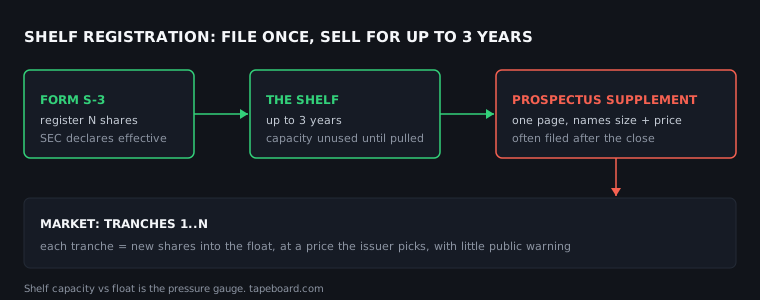
A shelf registration is a registration statement filed with the SEC under Rule 415 of the Securities Act that lets a company register a block of securities now and sell them later, in one or many tranches, whenever it wants during the next three years. The company files once, the SEC declares it effective, and the shares sit on the shelf. Each later sale only needs a small prospectus supplement rather than a full new registration. For traders, the practical meaning is blunt: an effective shelf means the company has a loaded dilution pipeline and can print new shares into your buy orders with little warning, at a price it picks.
How It Works
The mechanics, step by step:
1. Company files Form S-3 (or F-1/F-3 for foreign issuers) registering N shares
2. SEC reviews and declares the registration effective
3. The shelf is live for up to 3 years (Rule 415(a)(1))
4. When the company wants cash, it files a prospectus supplement
   (often the same evening) naming the amount, price, and underwriter
5. Shares can price overnight and settle fast, sometimes within 1-2 trading days
Form S-3 eligibility itself is a filter: the issuer must already be current on its SEC reporting, have traded publicly for at least 12 months, and meet public-float and debt-history conditions. Companies that lose S-3 eligibility fall back to the slower S-1 route, which is one reason a small cap losing S-3 status matters to traders.
Worked Example
Consider a hypothetical small cap with a 20 million share float that files a shelf for up to 50 million shares plus warrants. The effective shelf does not dilute anyone on day one. But the moment the stock rips on a promotional headline, the company can file a one-page supplement after the close and dump 10 million shares at a 15% discount overnight. If the offering prices at $4.00 against a $4.70 close, buyers the next morning wake up holding stock that opened near the raise price. The float expanded 50% in a single print. This is the standard pattern behind most overnight gap-downs on bulletin-board names, and it is why experienced traders check for an effective shelf before chasing low-float runners.
When Traders Check It
The shelf is the first thing to look up on any small-cap runner: a stock with no effective shelf cannot print shares into a squeeze, and a stock with a large shelf almost always eventually does. The relevant signals are the shelf's effective date, its size relative to the float, and how much of it is already used up. A two-year-old shelf with 90% of its capacity unsold on a name that just tripled is a short thesis with a deadline. A spent shelf means the next raise needs a new filing, which buys the squeeze time.
Tapeboard surfaces new S-3 and prospectus-supplement filings as they hit EDGAR in the filings feed, so the moment a shelf goes live or gets pulled down off the shelf, it is on the tape.
Limitations and Common Misconceptions
A shelf registration is a permission slip, not an obligation. Many effective shelves never get used, and registration size is an upper bound, not a plan. Treat shelf capacity relative to float as a pressure indicator, not a countdown timer. Also, an "automatic shelf" (Form S-3ASR, available to large seasoned issuers) is a different lane used by mega-caps for bond and bank-stock issuance; the small-cap dilution risk lives in the ordinary S-3 shelf. Finally, shelf sales are disclosed after the fact via prospectus supplements and Form 424(b) filings, so flow traders can be diluted before any news article is written.
Related Terms
Related reading: at-the-market offering (the most common way a shelf gets used), reverse split (the frequent companion move), Form 4 filings for insider selling, and the short squeeze mechanics a surprise raise can break.