Reverse Split Hell: The MULN to BINI Autopsy, Split by Split
Mullen Automotive ran nine reverse stock splits between May 2023 and September 2025, a cumulative 84,375,000,000,000,000-to-1 ratio, renamed itself Bollinger Innovations (BINI), failed Nasdaq's $35 million listing standard, and now trades over the counter near 4 cents with no SEC periodic filings in over a year.
Our first video: the case file
Today we published Tapeboard's first YouTube video. It is a case file: "He Made $49 Million. His Shareholders Lost Almost Everything."
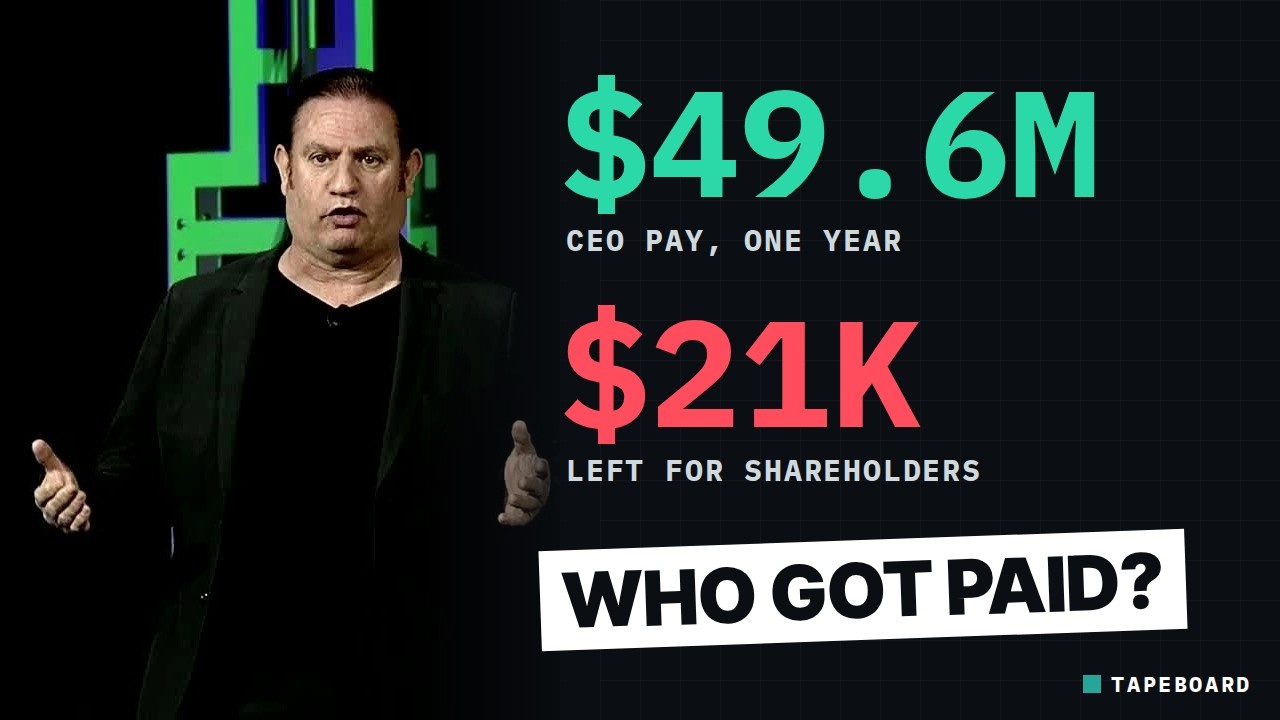
The subject is Mullen Automotive (MULN), an EV company that renamed itself Bollinger Innovations and became BINI in July 2025. The "$49 million" in the title is not an allegation; it is a line item in the company's own disclosure. Mullen's 10-K for fiscal 2023 reports CEO David Michery's total compensation as $49,629,463: a $750,000 salary and $48,879,463 in stock awards (10-K, filed January 17, 2024). The AFL-CIO's Executive PayWatch database carries the same figure. Stock awards are valued at grant; what they were worth by the time they vested is a different question, and the filings do not answer it.
What happened to the other side of the trade is the rest of this post. Every number below links to the filing that states it.
The split ledger: nine reverse splits in 29 months
Between May 4, 2023 and September 22, 2025, MULN and then BINI executed nine reverse stock splits:
| Effective date | Ratio | Register after the split | Source |
|---|---|---|---|
| May 4, 2023 | 1-for-25 | not stated in the 8-K | 8-K |
| Aug 11, 2023 | 1-for-9 | not stated in the 8-K | 8-K |
| Dec 21, 2023 | 1-for-100 | 6,552,470 by Feb 9, 2024 | 8-K, 10-Q cover |
| Sep 17, 2024 | 1-for-100 | 61,595,743 by late Jan 2025 | 8-K, 10-K cover |
| Feb 18, 2025 | 1-for-60 | 1,083,175 (split-adjusted) | 8-K, 10-Q cover |
| Apr 11, 2025 | 1-for-100 | ~2.4 million, from ~238.7 million | 8-K |
| Jun 2, 2025 | 1-for-100 | ~798,650, from ~79.9 million | 8-K |
| Aug 4, 2025 | 1-for-250 | 1,735,225, from 433,528,681 | 8-K |
| Sep 22, 2025 | 1-for-250 | 506,088, from 126,229,870 | 8-K |
The cumulative ratio is 25 x 9 x 100 x 100 x 60 x 100 x 100 x 250 x 250 = 84,375,000,000,000,000 to 1.
Every one of those nine 8-Ks states the same treatment for fractional shares: no fractional shares are issued, and each fractional share is rounded up to the next whole share. That policy has a brutal arithmetic consequence. Take a holder with 1,000,000 shares in April 2023, before the first split, who never sold:
- After the 1-for-25: 40,000 shares.
- After the 1-for-9: 4,444.44, rounded up to 4,445.
- After the first 1-for-100: 44.45, rounded up to 45.
- After the second 1-for-100: 0.45, rounded up to 1.
- Every split after that: 1 share, rounded up to 1.
A million-share position from before May 2023 is one share today, and BINI last quoted around 4 cents (StockAnalysis, October 2026). The position was never "wiped out" by any single event. It was ground down by nine rounds of arithmetic, each one individually legal, each one disclosed in an 8-K.
What a reverse split actually does
A reverse split changes nothing at the moment it takes effect. One hundred old shares at 10 cents become one new share at $10. The market cap is identical, the company is identical, your percentage ownership is identical. Mullen's own 10-K risk factors said the quiet part: a reverse split "may decrease the liquidity of the shares" and "may have a dilutive effect on the ownership of existing stockholders."
The function of a reverse split in a case like MULN's is not economics. It is listing compliance. The Nasdaq Capital Market requires a $1.00 minimum bid price (Listing Rule 5550(a)(2)), which is the rule every reverse stock split in this story was engineered to satisfy. A stock trading under $1 for 30 consecutive business days gets a deficiency notice and a clock. A reverse split multiplies the share price by the ratio and resets the clock. That is all it does, and that is precisely why companies that split once tend to split again: the split does not fix whatever pushed the price under $1 in the first place.
The register refills between splits
A reverse split shrinks the register. Issuing shrinks nothing. Read the ledger above again and watch what the register does between the splits:
- 1,083,175 shares outstanding (split-adjusted) at the February 2025 10-Q cover, filed one day before the February 18, 2025 split. By April 11, 2025, the pre-split register stood at 238.7 million shares, a roughly 220x refill in 53 days.
- 798,650 shares after the June 2, 2025 split. By August 4, 2025, the pre-split register stood at 433,528,681 shares, a roughly 540x refill in nine weeks.
- 1,735,225 shares after the August 4, 2025 split. By September 22, 2025, the pre-split register stood at 126,229,870 shares, a roughly 73x refill in seven weeks.
- 506,088 shares after the September 22, 2025 split, the one the company pledged would be the last for three years. The OTC ticker now shows about 17.25 million shares out (StockAnalysis, aggregator data on a non-reporting issuer), a roughly 34x refill in the year since.
The same pattern shows up in the offering pipeline: Mullen's S-1 and 424B registration filings run continuously through 2024 and 2025, with the last S-1 amendment filed September 19, 2025, and the registration withdrawn December 17, 2025 (all visible on the company's filing list on Tapeboard). The split compresses the register; the print queue refills it; the price bleeds back under $1; the cycle repeats. That is split hell, mechanically.
Nasdaq has a serial-splitter rule, and Mullen tripped it
On September 16, 2024, Nasdaq's Listing Qualifications staff sent Mullen a notice with two findings. First, the stock had closed under the $1.00 minimum bid for 30 consecutive business days. Second, and more unusual: the staff wrote that "the Company's implementation of one or more reverse stock splits within the past two years at a cumulative ratio of 250 shares or more to one" contravened Listing Rule 5810(c)(3)(A)(iv), which made the securities subject to delisting unless the company requested a hearing (8-K, filed September 20, 2024).
By September 2024 the cumulative ratio since May 2023 already stood at 2,250,000-to-1. Mullen requested the hearing and kept its listing, then executed five more reverse splits over the next twelve months.
The endgame: rename, delist, go quiet
- July 28, 2025: Mullen Automotive changed its name to Bollinger Innovations, Inc., and the ticker changed from MULN to BINI at market open (8-K).
- February 25, 2025: Nasdaq staff notified the company that its Market Value of Listed Securities had been under the $35 million minimum (Listing Rule 5550(b)(2)) for 30 consecutive business days, with 180 days to regain compliance, until August 25, 2025.
- August 26, 2025: Nasdaq notified the company it had not regained compliance; the company requested a hearing, which stayed the delisting (8-K).
- October 8, 2025: Nasdaq notified the company that trading would be suspended at the open on October 13, 2025. The company withdrew from the hearings process and moved the stock to the OTC Markets, where it still trades as BINI (8-K).
- November 21, 2025: management initiated further cost cuts: workforce reductions, closure of the Troy, Michigan office, consolidation into Oak Park, and notification to dealers that factory service and warranty support were being discontinued (8-K, filed November 26, 2025).
The reporting went quiet on the same schedule. The last periodic report Bollinger ever filed was the 10-Q for the June 2025 quarter. The fiscal 2025 10-K, due around the turn of the year, never arrived, and no late-filing notice was filed either. The company's own last filings were that November 8-K and a registration withdrawal in December 2025. A year later the ticker still quotes, near 4 cents, with a market capitalization around $700,000 and a 52-week range that includes a print at $0.000001 (StockAnalysis).
How you see split hell before it eats a position
The tells in this case file generalize, and none of them require reading between lines:
1. Serial reverse splits in the 8-K trail. This is the single loudest tell. Any sub-$5 name you are about to hold, pull its filing history first and count the reverse splits. One split is a flag. Two is a pattern. Nine is the whole story.
2. A rolling offering pipeline. S-1s, S-1/A amendments and 424Bs appearing every few months means the share-print queue is always loaded, which is exactly what refills the register between splits.
3. Bid-price deficiency notices (8-K Item 3.01). The deficiency letter is public the day it arrives. It tells you the clock is running on the next split.
4. The serial-splitter rule itself. If a company's cumulative reverse ratio crosses 250-to-1 inside two years, it is in Rule 5810(c)(3)(A)(iv) territory and the listing itself is in play, not just the price.
5. "This is the last reverse split" pledges. Made under a compliance deadline, they are a scheduling statement, not a covenant.
6. A name change mid-slide. Rebranding a fallen angel does not change the register, the float, or the print queue.
What Tapeboard shows you
This hazard class is exactly what several Tapeboard surfaces exist to surface, before the ninth split:
- The morning edition's Filings and dilution watch block covers overnight filings, dilution, reverse splits and halts every day (the Tapeboard morning edition).
- Scanner rows and cards carry dilution tags; clicking one opens the actual filing inside Tapeboard, where you can ask the in-app AI what it means.
- Filing cards parse and label reverse-split proposals in proxies and splits in 8-Ks automatically, and filings search takes topic words like
dilution,offering,ATM,shelfandreverse split. - Quote pages carry a dilution risk card in the research panel.
- The paper trading simulator applies splits and reverse splits to open positions, so the arithmetic above stops being abstract.
None of this is a crystal ball. The point is narrower and more useful: the split trail, the offering pipeline and the compliance notices are public documents, and they paint a legible picture long before the position grinds to a single 4-cent share. The scanner is free: scan the market free and read the filing trail before you hold anything.
Primary sources
Every number in this post comes from one of these documents, all retrieved October 12, 2026:
- SEC EDGAR filings for Mullen Automotive / Bollinger Innovations, CIK 0001499961: the nine reverse-split 8-Ks linked in the ledger above; the FY2023 10-K (executive compensation, reverse-split risk factors); the 10-Q and 10-K cover pages for share counts; the name-change 8-K, the MVLS 8-Ks, the delisting 8-K and the November 2025 cost-cut 8-K.
- CompaniesMarketCap MULN split history: the cumulative split multiple (one pre-May-2023 share equals roughly 3 x 10^-15 shares as of the August 2025 snapshot).
- StockAnalysis BINI quote: current price, market cap, shares outstanding and 52-week range for the OTC ticker.
- StockTitan BINI news feed: the company's September 2025 press releases, including the 1-for-250 split announcement (126.2 million shares reducing to about 505 thousand) and the "last reverse stock split for the next three years" pledge, and the October 2025 OTC Markets move.
- The AFL-CIO's Executive PayWatch database, which compiles CEO compensation from company filings: the same $49,629,463 fiscal 2023 total.
- YouTube: Tapeboard's case-file video, "He Made $49 Million. His Shareholders Lost Almost Everything."
Related reading: What is a reverse stock split?, What is a stock split?, What is a shelf registration?, What is free float?